
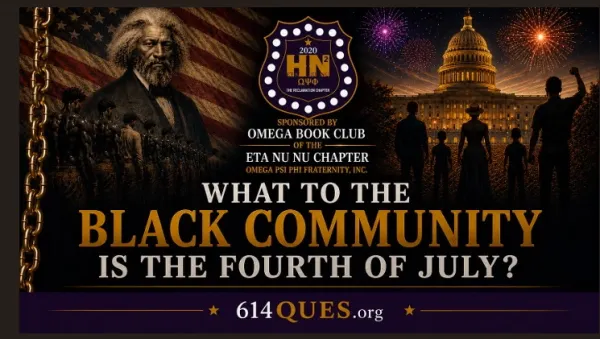
In 1852, Frederick Douglass, the great abolitionist and political figure delivered a lengthy and profound address in upstate New York at a meeting organized by the Rochester Ladies’ Anti-Slavery Society titled, “What to the Slave Is the Fourth of July?” This week marks the 250th anniversary of the signing of the Declaration of Independence which was adopted by the Continental Congress on July 4, 1776. In other words, this coming Saturday marks two and a half centuries since the thirteen colonies-Virginia, Massachusetts, New Hampshire, New York, Maryland, Connecticut, Rhode Island, Delaware, North Carolina, South Carolina, New Jersey, Pennsylvania and Georgia-declared their independence from Great Britain. The title of this article is admittedly a shameless, but necessary appropriation of Douglass’s speech.
Given the trials and tribulations that African descended people in America continue to face Douglass’s question-modified of course for contemporary times-strikes the men of Eta Nu Nu as most appropriate. On Wednesday July 1, 2026, the men of the Eta Nu Nu chapter of the illustrious Omega Psi Phi Fraternity, Inc., held a two-hour forum that addressed the following question: What to the Black Community Is the Fourth of July? To no one’s surprise Frederick Douglass and his life’s work figured prominently in the discussion. As both public, private as well as government entities and institutions go to great lengths to commemorate this 250th anniversary African Americans would do well to reflect on the meaning of the Fourth of July and its significance or lack thereof as Black people continue to engage in a protracted struggle to move America closer to honoring the values and principles that appear in the country’s three most sacrosanct documents-the Declaration of Independence, the Bill of Rights and the U.S. Constitution.
Things such as “life, liberty and happiness,” “protecting the fundamental civil liberties of individuals,” “fair and legal processes” and the notion of “popular sovereignty” are ideals that have fallen short where Black people are concern. How could it have been any different? After all, three of the five men (Jefferson, Benjamin Franklin and Robert Livingston) that comprised the committee responsible for crafting the Declaration of Independence were slaveholders. All told, more than “70% of the 56 signatories of the Declaration of Independence held enslaved people.”
What’s more, twelve of the first twenty U.S. presidents were slaveowners. Dr. Martin Luther King, Jr. once submitted, “all we say to America is, be true to what you said on paper.” Dr. King was either hopeful or naïve. Fifty-eight years after the murder of the fallen hero the dream about which King so eloquently spoke remains deferred and the words that appear on the parchment paper out of which the documents referenced above were created are little more than promises unfulfilled.
What many Americans may not realize is that thousands of Blacks fought in the revolutionary war with the hope that the freedom and independence for which they were fighting would extend to them. They were mistaken. If African Americans are to honor anything it should be the memories of those Black soldiers who gave of their lives for a cause that was never intended for them to enjoy.
Judson L. Jeffries, PhD, MPH, is Professor of African American and African Studies at The Ohio State University.